Five focused sessions drawn from Calvin's front-line work in digital identity, inclusive technology, and leading teams through AI-era disruption. Each is visual, demo-heavy where it applies, and tailored to the real constraints organizers face.
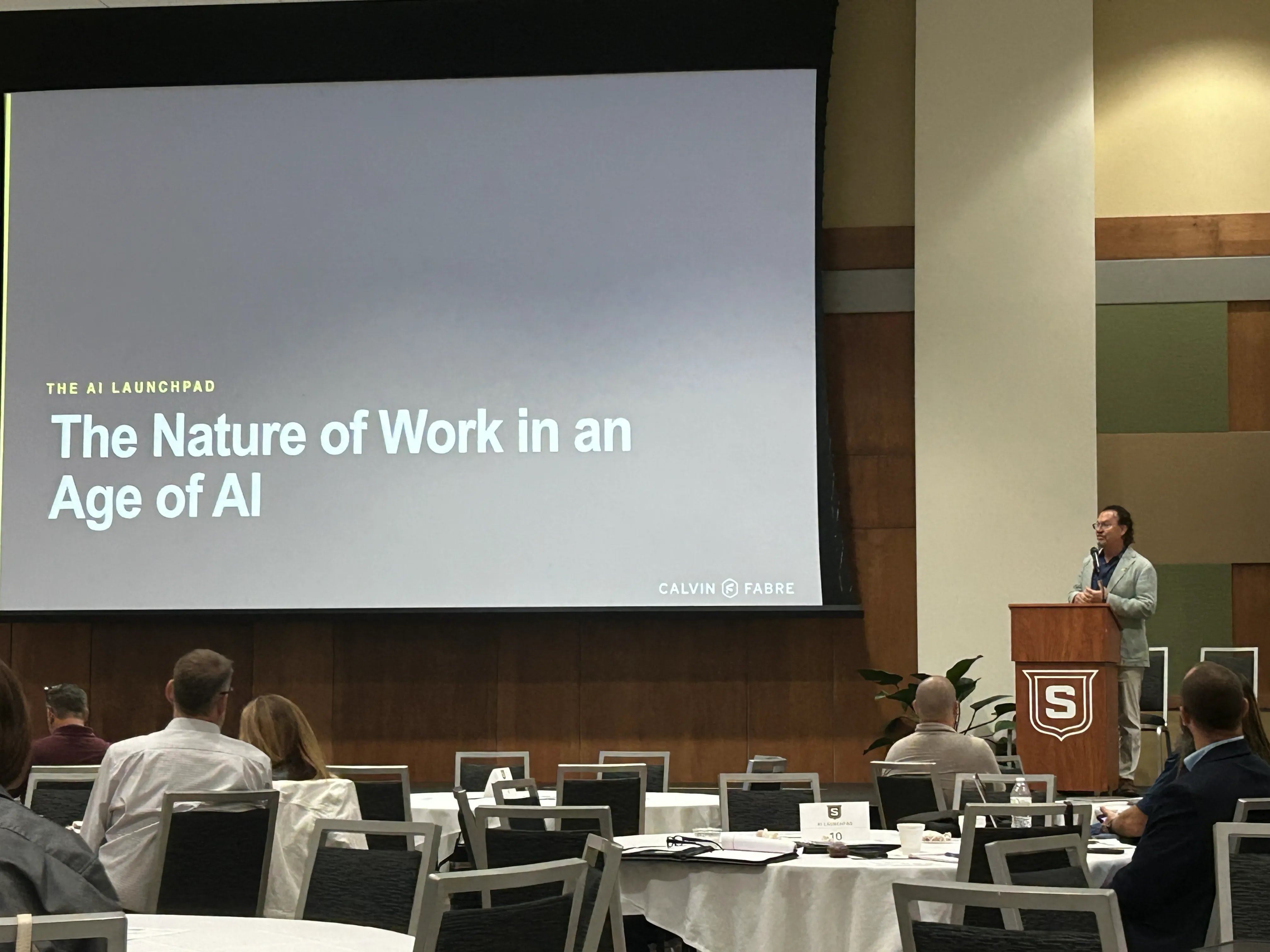
The Nature of Work in the Age of AI: Prevailing When the Brain Meets the Machine
Every major technological shift has been sold as the end of human labor — and every time, the work continued. It changed shape. Calvin traces a line from the agricultural age through the industrial revolution to today's AI moment, asking what actually gets replaced when machines grow smarter, and what never can. This is a talk for technology leaders who refuse to panic: a framework for keeping human judgment, human touch, and human purpose at the center of the work — and for using AI as leverage, not a rival.
45–60 minutes
- Why the steam engine, the assembly line, and the large language model rhyme — and what we keep getting wrong about "replacement"
- Work reframed: arranging a disordered domain into order so people can flourish — a definition that outlasts every tool
- What AI threatens in the human mind, what it cannot touch, and why that boundary matters for every technology career
- Practical posture for teams: dominate, guide, and leverage AI without surrendering the human aspects that make work worth doing
Audience: Technology executives, engineering leaders, university audiences, and conference organizers exploring AI's impact on careers, teams, and the purpose of work.
Book this talk AI-Empowered Fraud Vectors: Why 'What You Know' and 'What You Have' No Longer Count
Deepfake IDs, synthetic identities, and AI-phishing have broken traditional authentication. Calvin shows how shifting to 'who you are' — through biometric binding and cryptographic proof — is the only way to stay ahead of fraudsters.
60 minutes
- How AI has turned identity theft from a crime into a commodity: deepfake IDs, synthetic identities, and automated phishing at scale
- Why passwords and documents (what you know/have) are fundamentally broken against modern AI attacks
- The biometric binding approach: cryptographically tying identity to a living person's biometric traits
- Real LA Wallet anti-fraud architecture: liveness detection, face-matching thresholds, and the numbers that matter
- Live demo: walking through a fraud attempt in real time and showing how the system detects and blocks it
Audience: Security teams, fraud prevention leaders, identity platform architects, and enterprise executives responsible for protecting user identity.
Book this talk Ghost Students and the Live Person: What Community Colleges Need Before the Next Disbursement
Community college systems are being asked to enroll at a distance and disburse aid at speed. Fraud rings have noticed. This talk starts with the fraud, not the product. Calvin walks chancellors, aid directors, and campus IT through why a document photo plus a selfie does not prove a live student, why a mobile driver's license raises the trust of the source photo, and how a campus can mint an updatable student ID into Apple Wallet or Google Wallet that stays bound to a live face through a UR Code. Students without a flagship phone still receive the same credential on a printed card.
60 minutes
- The ghost-student pattern: a remote application, a stolen or synthetic identity, aid that leaves, and a seat that stays empty
- Educate the campus first: what fails in a document-only or 2D selfie check, and why what you know and what you have do not close the analog gap
- Liveness as the control that has to come before disbursement: a physically present human, not a replay, a mask, or an injected deepfake
- Mobile driver's licenses as a higher-trust photo source under ISO 18013-5 and 18013-7, and why a secure mDL in the wrong hands still fails the analog-gap test
- Minting an updatable student ID into Apple Wallet or Google Wallet, face-bound with a UR Code that any smartphone can re-check later
- The same credential as a printed card, so low-income and technology-avoidant students are not designed out of the system
- What a community college system can ask for in a scoped pilot before the next aid cycle
Audience: Community college chancellors, system offices, enrollment and financial-aid leaders, campus IT, and organizers booking a speaker for higher-education fraud, identity, or student-success programs.
Book this talk Not Every Resident Has a $1,200 Phone: Building Digital Services That Don't Leave People Behind
A hard look at how digital government services can disenfranchise low-income families, seniors, and rural communities — and practical, demo-driven strategies to build inclusion into every layer of identity systems.
60-90 minutes with Q&A
- Why smartphone requirements are the single biggest barrier to digital inclusion for government services
- How printed credentials (paper receipts, QR codes, NFC stickers) keep people in the system without a phone
- The biometric binding layer that lets anyone prove 'who they are' without expensive hardware
- Real LA Wallet lessons: where digital-first design excluded the people it was meant to serve
- Live demo: showing the multi-channel verification flow — phone, printed credential, and biometric fallback
Audience: Government agencies, civic technology teams, accessibility advocates, and public-sector IT leaders designing citizen-facing services.
Book this talk The State of Digital Identity: Privacy, Standards, and What It Means to Prove Who You Are
What it means to prove who you are in a digital world — the standards, the privacy tradeoffs, and the policy decisions that shape how identity works for everyone. Calvin walks through the real engineering, policy, and privacy tradeoffs of deploying the first legal digital driver's license at state scale, anchored by the NoPhoneHome privacy principles: purely optional, no copies, nothing extra.
45-60 minutes
- How mobile driver's licenses work technically and legally: the RPO, the cryptographic binding, and the trust chain
- The privacy-preserving design patterns that make digital ID trustworthy — purely optional, never mandated
- How ISO 18013-5 shapes the future of interoperable digital credentials across borders
- What state and federal policymakers need to understand about mDL deployment before they fund it
- Why personal data should live at its source on the device and nowhere else — where nothing is stored, there is nothing to breach
- Selective disclosure: the principle that people should always share only what's necessary, nothing more
- Live demo: walking through the verification flow end-to-end, from citizen phone to verifier terminal
Audience: Government agencies, policy makers, technology leaders, standards bodies, and enterprise teams evaluating digital identity infrastructure.
Book this talk 

 Upcoming